
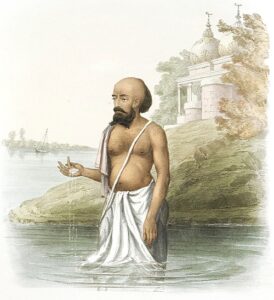
 There are six auxiliary disciplines associated with Vedic learning and in order to comprehend even one hymn of any Veda it is imperative that there is some expertise in these disciplines. The word vedāñga is derived from Veda (perfect knowledge) and añga (limb or body part). Each of these disciplines is symbolised by a vital body part of Kālapuruṣa (time personified). These six vedāñga are śikṣā, chandas, vyākaraṇa, nirukta, jyotiṣa and kalpa respectively representing the nose, feet, face, ears, eyes and the hands of Kālapuruṣa. These are further mapped to the elements of creation – earth (pṛthvi), vāyu (air), water (jala), ākāśa (ether), agni (fire) and manas (mind, consciousness) respectively. Traditionally, vyākaraṇa and nirukta are common to all four Vedas, while each veda has its own śikṣā, chandas, kalpa and jyotiṣa texts. Further, they are grouped in pairs for study – (A) śikṣā and chandas form the first group that studies the language structure, (B) vyākaraṇa and nirukta go into the roots and the formation of sounds and words; the grammar is very mathematical and rules are tight, (C) jyotiṣa and kalpa form the esoteric group that requires very deep study and initiations.
Śikṣā – The Language
Superficially, it comprises proper articulation and pronunciation of letters, accents, quantity and phonetics generally, but especially the laws of euphony peculiar to the Veda. Śikṣā is the nose of Kālapuruṣa, the organ of smell which is the dharma of pṛthvi tattva, the earth element. Mercury, one of the navagraha closest to the Sun, rules over this element. It leads the way and shows what and how we get into anything. It shows our conversation skills, communication abilities, the form of the body and so many other seemingly unrelated things get linked through the dominance of the earth element and Mercury. Therefore, language and pronunciation are key to determining where we come from as the accents and pronunciation as well as verbiage and vocabulary vary over relatively short distances.
Language of the Veda which is Sanskrit with its phonetics and phonology (saṅdhi) is termed śikṣā. A body of knowledge needs a language as a medium of instruction. The language can be simplistic for simple subjects whereas it needs to be near to perfect in dealing with all sounds if the subject is complex.
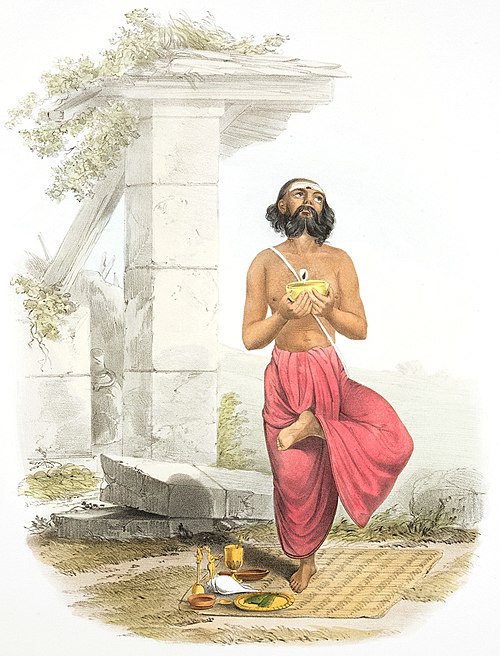
Of course the obvious use of śikṣā was to train the young Brahmin boys to learn the correct recitation of Vedic hymns but some of them were chosen to go further into master the science of sound called mantra śāstra. Śikṣā teaching was based on the prātiśākhya[1] books and each school had their own. Prior to the advent of Kali Yuga, these schools relied on the ancient padapāṭha but later, had their own prātiśākhya books and later these grew and further diversified into about forty-four primary śikṣā books (ancient India) and many others of later years.
What these schools large taught was clarity of Sanskrit pronunciation and in due course of time we have a clear divide showing north and south of Orissa. For example the word bṛhaspati (बृहस्पति) is pronounced as brihaspati (ब्रिहस्पति) with an ‘i’ in north India while in Orissa and the south it is bruhaspati (ब्रुहस्पति) with a ‘u’. The Oriyas argue that their pronunciation is correct as (1) Adi Śaṅkara choose Puri to be the holder of the Ṛk Veda largely because of the unchangeable[2] nature of the brahmins of this place and (2) the ṛ (बृ = ब + ऋ) mātrā as in bṛhaspati (बृहस्पति) is under the consonant ba (ब) just like u (उ) under bru (ब्रु) while i (इ) is above implying a completely different pitch. Mātrā above the letters are high pitch while those below are low pitch. One effect of Kali Yuga is already evident in that neither knows the correct sound as it is neither u (उ) nor i (इ) but is ṛ (ऋ) which may be closer to u (उ) but is not u (उ). The process of expansion and simplification has had its first victim in the letter ṛ (ऋ) as is ṛṣi or Maharṣi or Bṛhaspati, as we do not know its perfect pronunciation anymore. We really don’t know how to say these words perfectly anymore and these words connect us with the seers! Imagine our despair.
[1] derived by lengthening ‘prati-śākhā’ where sākhā refers to the Vedic school under a seer.[2] Steady like the Sun – Orissa (Kaliñga is ruled by Sun as taught by Varahamihira in Bṛhat Saṁhitā)

 DBC offers online courses in jyotish (Vedic Astrology) taught directly by Sanjay Rath as per the tradition, through narrated power points and other audio tools. The courses are at different levels, from the beginners through the intermediate to the advanced and are known as SoHamsa | DBC courses, with individual classrooms and assistant teachers
 Sagittarius Publications is the publisher and distributor the popular quaterly magazine the Jyotish Digest, as well as many thorough books on the subject of Vedic Astrology or Jyotish.