
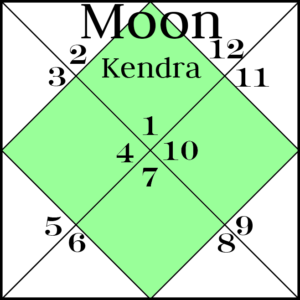
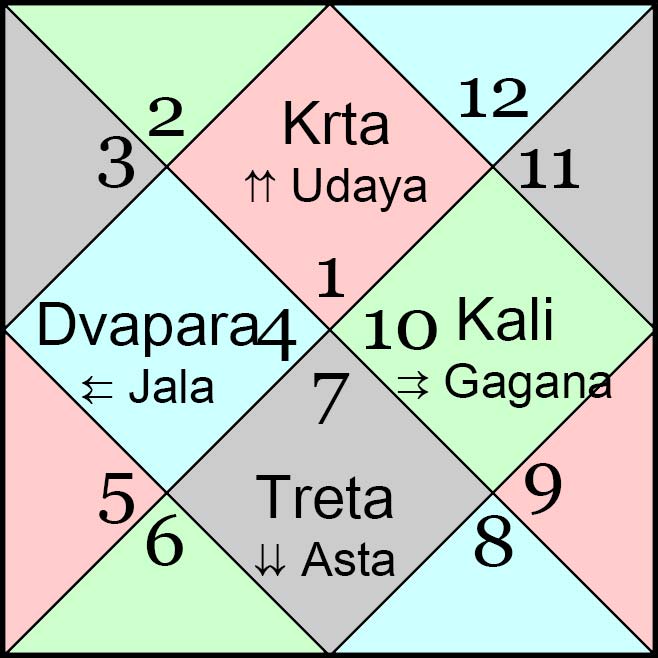
 A chart of the heavens drawn from the Moon as the ascendant is called Chandra Chakra.
hrāṁ = Everywhere
ह्रा hrā – a vein, artery
हृ + आं = ह्रां [hṛ + āṁ = hrāṁ]
hrā + nāda = hrāda m. sound, noise, roar (of thunder)
ह्रादिन् hrādin – noisy , very loud, lightning, Indra’s thunderbolt
The first function of the manas is to pump blood through the arteries in a rhythmic sound (nāda) of the ḍamaru. This is the मन (mana) – first of pañca-mana which creates all thoughts
Mo-1H is life and our consciousness of ourselves. So this chandra chakra is the blood that creates us.
① Śubhapati is the giver of food – it is the lord of the moon sign and there can only be one who feeds the body.
If there are two lords, one feeds the body and other feeds the mind. Always take the stronger as per Jaimini bala rules to choose who is stronger of the two rāśi lords. Native will belong to the kula of this stronger lord as it is the maker of his blood. It is the retas of the father, the sthira pitṛ kāraka that created him. If this planet is chara ātmakāraka then the native belongs to a family of Śiva, a śaiva by birth and soul right.
② ṛkṣa-patī is the lord of janma nakṣatra. This ṛkṣa-patī feeds his mind and destiny as the mind surely rules one’s destiny. This shall make decisions and cause suffering or otherwise based on the decisions. The janma nakṣatra is the य (ya) sound of vāyu that created the mind and makes it so fast. It gives prāṇa to the native through the breath. So we breathe through the janma nakṣatra and this is the dominant tattva of this first nakṣatra.
Just as there are pañca manas, there are pañca prāṇa.
When we say ह्रां hrāṁ we are talking about the sunlight reflected through the moon, this is a tithi really. And when we talk of श्रां śrāṁ we are talking of the moon alone. The moon does not have its own light. It merely reflects the light of the Sun and that too in such grandeur by filtering out the burning yellow and keeping only the soothing mild-blue. Except during eclipses and other times when it does throw up other colours. What is a blood-moon or a blue-moon? What are these names given to the moon and why?
AYURVEDA Jyotisa Lesson
The Moon has vāta and kapha » vāta is the vāyu element → that य (ya) in the nakṣatra and the kapha is the sattva guṇa that is in the janma rāśi. Therefore, the janma rāśi lord is primarily taken to be Viṣṇu avatāra also.
Prakṛti has three aspects – vāta, pitta and kapha. They are mixed in different proportions with a dominance of either of the three as vāta, pitta and kapha or a dominance of two factors as (a) vāta + kapha (b) vāta + pitta or (c) pitta + kapha and finally there is a mixture where none dominates and keeps changing vāta + pitta + kapha. Now list all these seven and we get the seven weekday planets. This is the basis of the ayurveda of the graha.
1. Vāta » śani graha with strong desire to run when he can barely walk
2. Pitta » sūrya graha with strong fire
3. Kapha » bṛhaspati graha with strong field to influence and protect all
4. vāta + kapha » chandra graha
5. vāta + pitta » maṅgala graha
6. pitta + kapha » śukra graha
7. vāta + pitta + kapha » budha graha
This last one of changeable vāta + pitta + kapha is very dangerous. This can have any one of the three marginally dominating like this
7. vāta + pitta + kapha↑ » kapha dominates in pṛthvī graha Budha
8. vāta↑ + pitta + kapha » vāta dominates in Rāhu
9. vāta + pitta↑ + kapha » pitta dominates in Ketu
And in this manner, we have the navagraha. And because of having the pure vāta, pitta and kapha, Śani, Sūrya and Bṛhaspati are the mahā graha. When they form trines they activate the jñāna-trikoṇa which is called a mahā vidyā.


 DBC offers online courses in jyotish (Vedic Astrology) taught directly by Sanjay Rath as per the tradition, through narrated power points and other audio tools. The courses are at different levels, from the beginners through the intermediate to the advanced and are known as SoHamsa | DBC courses, with individual classrooms and assistant teachers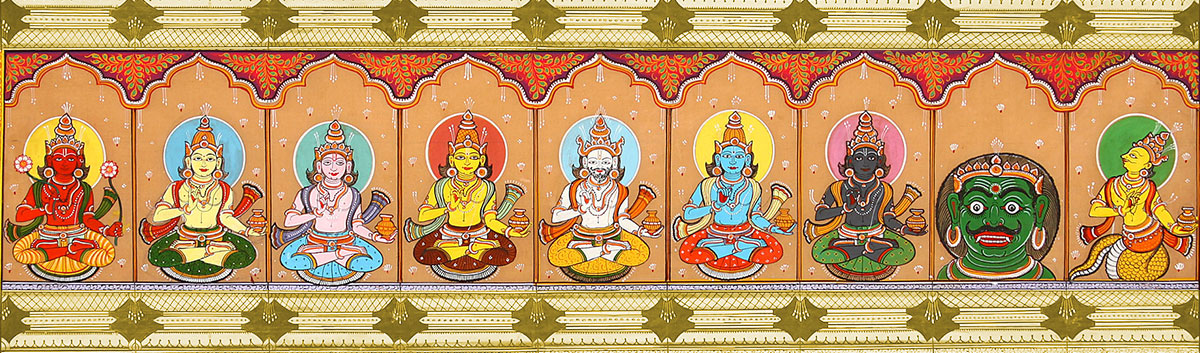
 Sagittarius Publications is the publisher and distributor the popular quaterly magazine the Jyotish Digest, as well as many thorough books on the subject of Vedic Astrology or Jyotish.