
Chandas – The Rhythm
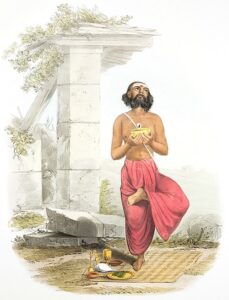 It is the meter in which the words and sounds are ordered. It is the emotional content of the Veda and shows the flow of energy. There are various meters and they have a fine jyotiṣa principle associated called bhavat-bhāvaṁ. A treatise titled ‘Chandas’ by Piṇgala-nāga lists some of these meter which are based on (1) pāda (foot) which comprises four syllables and (2) pāda (footstep) which comprises eight syllables which is two pada. The famous gāyatrī chandas, for example, is tri-pāda or 24 syllables (3 x 8 = 24). However, in most books this differentiation between pada and pāda is almost missing and often interchangeable.
Pada
Chandas is the foot of the Kālapuruṣa and shows how we journey through life, how we connect with other beings – both animate and inanimate including God. Wind causes movement and the feet connect with vāyu tattva, the air principle. Saturn a windy planet with many storms signifies the coldness or temperature gradients that cause the wind to flow, that cause movement.
Gāyatrī chandas with its tri-pada footsteps shows how we manifest divinity while the anuṣṭubh chandas with its ‘four pāda’ footsteps is a follower, following in praise, the gāyatrī. Mathematically the perfect 4 pāda would have 32 syllables (4 x 8 = 32). Prayers, hymns and teachings that are in gāyatrī chandas manifest the divine within us while those in anuṣṭubh cause us to follow the divine, the master or his teachings. Now if a book were to be written for posterity which was to be the basis for learning vedāñga jyotiṣa, what chandas is better than anuṣṭubh where we can follow the master and swim across this huge ocean of knowledge instead of drowning midway. For this reason Parāśara has chosen to write his monumental classic ‘Bṛhat Parāśara Horā Śāstra’ in the anuṣṭubh chandas.
Chandas variety
The original footstep can have different lengths based on the syllables in it besides being of three or four steps. Some examples are listed and we learn that the universe was created with a meter having twelve syllables, the jagatī chandas that creates the jagat (universe).
- Gāyatrī – 3 pada of 8 syllables per pada = 24 syllables [defines God, divinity, trines]
- Anuṣṭubh – 4 pada of 8 syllables per pada = 32 syllables [defines life directions]
- Pañkti – 4 pada of 10 syllables per pada = 40 syllables [defines karma directions]
- Triṣṭubh – 4 pada of 11 syllables per pada = 44 syllables [defines Rudra]
- Jagatī – 4 pada of 12 syllables per pada = 48 syllables [the universe ~ jagat]
Mixing of pada
Some chandas are created by mixing pada from the above which can give birth to new chandas. For example the uṣṇih chandas is created using two 8-syllable pada and one 12-syllable pada giving a 28 syllable chandas (8+8+24 = 28).
Original uṣṇih = 8+8+12, which has the effect of 28 = 4 x 7-syllable pada. In this manner the new chandas created from the standard ones will also have a divisibility by 4 to get the effective pada length. This is not done arbitrarily but in steps of 4 syllables which is called the mantra-pada. We can see how the gāyatrī was increased to the uṣṇih chandas in one mantra-pada where 24 (gāyatrī syllable) plus 4 (mantra-pada) equals 28 (uṣṇih syllable).
There can be variations to this uṣṇih chandas with the kākubh chandas (8+12+8) which has the longer 12 syllable pada in the middle instead of the end.
Short or excess syllables
What happens to the chandas in between? The mantra-pada also defines the stretch and the 4 pada can be divided along the middle point allowing a stretch factor of 2 syllables either way. The Gāyatrī chandas can stretch to 26 syllables (24+2), or 25 syllables (24+1) or can be compressed to 22 syllables (24-2) or 23 syllables (24-1). In this case the stretch of a maximum of 2 syllables is allowed on either side of the middle point of 24 syllables. The compressed short chandas of 22 or 23 syllables are said to be trying to expand all the time to the middle point, bringing in growth or expansion while the longer expanded ones of 25 or 26 syllables are trying to shed the excess and have a compression tendency. For this reason, the shorter ones are preferred to longer ones. Consider the well known gāyatrī mantra –
tat savitur vareṇyaṁ| bhargo devasya dhīmahi dhiyo yo naḥ pracodayāt||
Complete syllables: ta, sa, va, ta, va, ra, ya = 7 syllables in 1st pada
bha, ga, de, va, ya, dha, ma, ha, = 8 syllables in 2nd pada
dha, ya, ya, na, pa, ca, da, ya = 8 syllables in 2nd pada
Total = 23 syllables in 3 pada which is short of the required 24 by 1 syllable.
This shortage of one syllable makes it a nicṛt (निचृत्) gāyatrī chandas, incomplete and defective in some manner, yet expansive and seeking to grow. That one syllable that is prefixed to this hymn which makes it manifest the divine in us, is the brāhmaṇa upadeśa given with the sacred thread.
A shortage of 2 syllables will make it a virāj gāyatrī where virāj means a king, ruler, the Sun, king of birds – Garuḍa etc. We notice that the hymn would then have 22 syllables (24-2 =22). The famous dakṣiṇa kali mantra has 22 syllables. Virāj is also applied to pañkti meter of 40 syllables where the pada are each of 10 syllables. Here the number 10 represents the ruler, king or the throne of heaven and is said to be created by reducing the universe (jagatī) 12 syllable pada by 2 syllables.
Short or Excess Pada
Chandas can be formed by short or excess pada as well. The dvi-pada gāyatrī is a meter of 16 syllables formed by two 8-syllable pada. In these lines examine (1) the bṛhatī chandas of 36 syllables or (2) the dvi-pada virāj chandas of 20 syllables.
The pañkti chandas can also be formed, more appropriately by 5 pada of 8-syllables each (5 x 8 = 40). Refer to previous definition of 40 syllables. In this chandas, the pañkti is created with gāyatrī pada and after every five pada of 8 syllables, it is said to create a new generation in an order called pañkti karma. This is the 8-year series: Generation A: 8, 16, 24, 32, 40; Generation B: 48, 56, 64, 72, 80; Generation C: 88, 96, 104, 112, 120 years.
However, when the pañkti chandas is in the virāj chandas patter of 4 x 10 = 40, it creates a completely different series of 5 years each. This is the 5-year series called pañca svara daśā or pañca saṁvatsara yuga:
Generation A: 5, 10, 15, 20, 25, 30, 35, 40;
Generation B: 45, 50, 55, 60, 65, 70, 75, 80;
Generation C: 85, 90, 95, 100, 105, 110, 115, 120 years.
It is interesting how we have converted the syllables of the rhythm (chandas) into years of life. Study these chandas names carefully and you will learn how the meter manifests. Life is a flow, a symphony and we enjoy life when we are flowing in the right chandas, else it is cacophony.
Celibacy Years
The Ṛk Veda teaches that a person maintaining perfect celibacy for 33 years is like Āditya while one doing so for 44 years is like Rudra. This does teach us that celibacy is counted in multiples of 11 years and we know that the triṣṭubh chandas has 44 syllables where each pada has 11 syllables. The old Vedic virāj was a triṣṭubh chandas which was short of one pada i.e. 3 x 11 = 33 syllables. It becomes easy to understand that celibacy can easily be maintained by reciting hymns in the 11 syllable meter. And later when we learn the bhavat-bhāvam principle, we will understand how the 11-syllable originates from the 6th house which rules over celibacy.



 DBC offers online courses in jyotish (Vedic Astrology) taught directly by Sanjay Rath as per the tradition, through narrated power points and other audio tools. The courses are at different levels, from the beginners through the intermediate to the advanced and are known as SoHamsa | DBC courses, with individual classrooms and assistant teachers
 Sagittarius Publications is the publisher and distributor the popular quaterly magazine the Jyotish Digest, as well as many thorough books on the subject of Vedic Astrology or Jyotish.