
Jyotiṣa – The Vision
 The word jyotiṣa has various meanings starting with Sun as source of all light including –
- an astronomer who deals with gaṇita śāstra – first division of jyotiṣa, and prepares almanacs, predicts eclipses and other heavenly phenomena.
- one adept at mystical formulae, particular magical formula for exorcising evil spirits (mantra śāstra) besides the study of omens and dreams (Nimitta śāstra) which is the second division of jyotiṣa called saṁhitā.
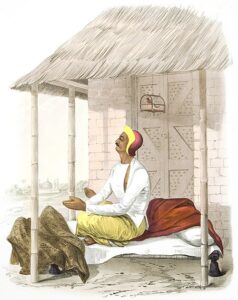
- astrologer, who comprehends the movements of heavenly bodies, divisions of time, symbols and significations which is the third division of jyotiṣa. He uses this information for election dates and times, horoscopy and a host of other purposes. This is the third Skanda (division) called Horā śāstra which is the subject of this course.
Jyotiṣa is signified by Agni tattva which is ruled by the planet Mars. The Sun and Ketu (dragon south node) are two other planets having a predominance of Agni tattva. Vision and form are the blessings of agni tattva. We have used a forced definition of the word planet for the word graha in jyotiṣa. Although the luminaries Sun and Moon and the nodes Rāhu and Ketu are not planets, yet we have used this definition of planet to include them for astrology study. The main reason for doing so is the lack of an equivalent English word for the Sanskrit term ‘Graha’.
The field of Jyotisha deals with ascertaining time, particularly forecasting auspicious day and time for Vedic rituals.[14] The field of Vedanga structured time into Yuga which was a 5-year interval,[42] divided into multiple lunisolar intervals such as 60 solar months, 61 savana months, 62 synodic months and 67 sidereal months.[43] A Vedic Yuga had 1,860 tithis (तिथि, dates), and it defined a savana-day (civil day) from one sunrise to another. Besides the Rk Veda, time keeping concepts are found in the Sanskrit verses of the Shatapatha Brahmana, a 2nd millennium BCE text. Jyotisha texts present mathematical formulae to predict the length of day time, sun rise and moon cycles.
The length of daytime = 12+ (2/61) x N muhurta where (a) N is the number of days before or after the winter solstice and (b_ muhurta = 1/30 part of a day = 48 minutes average.
Rāśi – Vedic signs
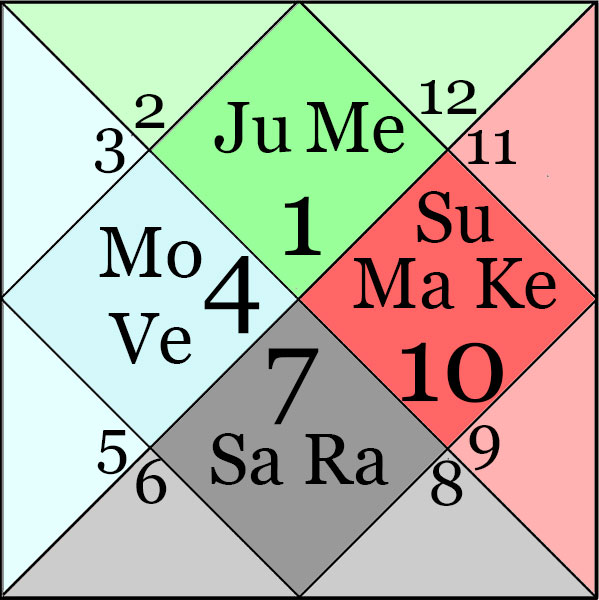
Nirayana, or sidereal zodiac, is an imaginary belt of 360 degrees, divided into 12 equal parts. Each part of 30 deg is called a sign or rāśi. The Sāyana, or tropical zodiac, is exactly similar except that it ignores the stars completely whereas the Nirayana is wholly based on the stars and is derived from it.
| № | Sanskrit | Trans | Starting | Representation | English | Element | Mobility | Lord | |
| 1 | मेष | Meṣa | 0° | ram | Aries | Fire | Chara | movable | Mars |
| 2 | वृषभ | Vṛṣabha | 30° | bull | Taurus | Earth | Sthira | fixed | Venus |
| 3 | मिथुन | Mithuna | 60° | twins | Gemini | Air | Dvisvabhava | dual | Mercury |
| 4 | कर्क | Karka | 90° | crab | Cancer | Water | Chara | movable | Moon |
| 5 | सिंह | Siṃha | 120° | lion | Leo | Fire | Sthira | fixed | Sun |
| 6 | कन्या | Kanyā | 150° | virgin girl | Virgo | Earth | Dvisvabhava | dual | Mercury |
| 7 | तुला | Tulā | 180° | balance | Libra | Air | Chara | movable | Venus |
| 8 | वृश्चिक | Vṛścika | 210° | scorpion | Scorpio | Water | Sthira | fixed | Mars |
| 9 | धनुष | Dhanuṣa | 240° | bow and arrow | Sagittarius | Fire | Dvisvabhava | dual | Jupiter |
| 10 | मकर | Makara | 270° | crocodile | Capricorn | Earth | Chara | movable | Saturn |
| 11 | कुम्भ | Kumbha | 300° | water-bearer | Aquarius | Air | Sthira | fixed | Saturn |
| 12 | मीन | Mīna | 330° | fishes | Pisces | Water | Dvisvabhava | dual | Jupiter |
Nakṣhatras – lunar mansions
The nakshatras or lunar mansions are 27 equal divisions of the night sky used in Hindu astrology, each identified by its prominent star(s). There is the 28th inter-calary nakshatra called Abhijit which overlaps the 21st and 22nd Nakshatra.
Each Nakshatra spans 13° 20′ of the ecliptic. The missing 28th nakshatra is Abhijit. Each nakṣatra is divided into four equal quarters or padas of 3° 20′. Of greatest importance is the Abhiśeka Nakṣatra, which is held as king over the other nakṣatras. Worshipping and gaining favour over this nakṣhatra is said to give power to remedy all the other nakṣatras, and is of concern in predictive astrology and mitigating Karma.
The 27 nakshatras are:
- Ashvini
- Bharni
- Krittika
- Rohini
- Mrighashirsha
- Ardra or Aarudhra
- Punarvasu
- Pushya
- Aslesha
- Magha
- Purva Phalguni
- Uttara Phalguni
- Hasta
- Chitra
- Swati
- Vishakha
- Anuradha
- Jyeshtha
- Moola
- Purvashada
- Uttarashada
- Shravana
- Dhanishta
- Shatabhishak
- Purva Bhadra
- Uttara Bhadra
- Revati
The junction of two rashis as well as Nakshatras is known as Sandhi.

 DBC offers online courses in jyotish (Vedic Astrology) taught directly by Sanjay Rath as per the tradition, through narrated power points and other audio tools. The courses are at different levels, from the beginners through the intermediate to the advanced and are known as SoHamsa | DBC courses, with individual classrooms and assistant teachers
 Sagittarius Publications is the publisher and distributor the popular quaterly magazine the Jyotish Digest, as well as many thorough books on the subject of Vedic Astrology or Jyotish.