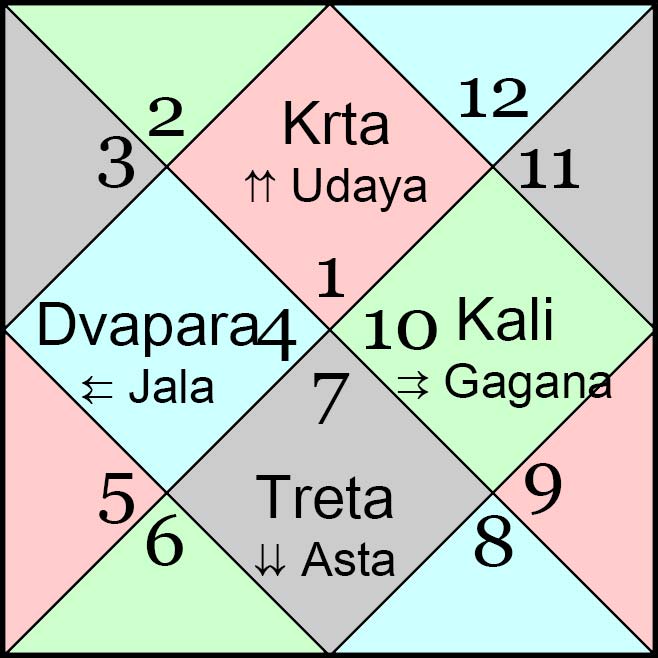
UDAYA LAGNA: Earth Throne
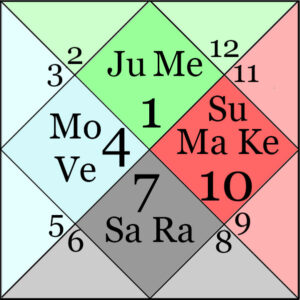 Study the graha having dual natures – Chandra, Śukra, Maṅgala have strong duality in their nature while Budha, Rāhu and Ketu have multiplicity.
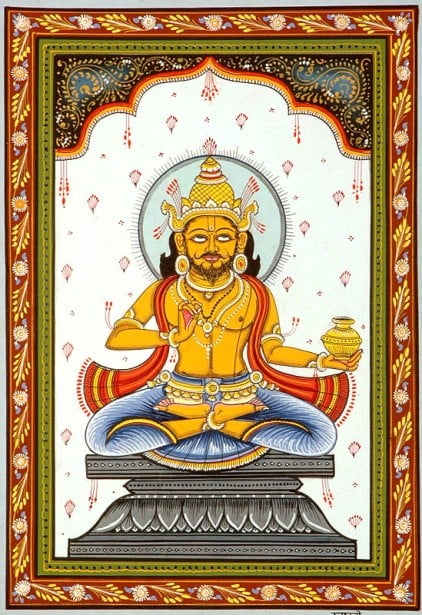
Budha gets its vāta + kapha from Chandra and pitta + vāta from Tārā » father and mother of Budha respectively. This makes it tridoṣa graha. Budha has a tendency to make kapha strong. This tendency endears him to Bṛhaspati. Devaguru accepts him as a putra (son in guru-kula) and takes him as śiṣya of the learning process. Because of having full kapha Bṛhaspati is seated in head (lagna) when teaching and Budha must also sit there in the lagna to continue to increase kapha and learn. Hence Bṛhaspati and Budha have digbala in the Lagna and know what they are doing – sharing knowledge.
All human beings have tridoṣa due to birth from the mating between Chandra (father) and Tārā (Nakṣatra). We are all tridoṣa like Budha and spend our entire life learning something when the kapha element dominates in us.
AKASHA LAGNA: Svarga Throne
Agni tends to rise to the sky. Wherever there is a flame, it is always rising upwards to the sky. Carefully list the graha with the dominant pitta » sūrya is pure pitta, maṅgala is pitta↑ + vāta, Ketu is vāta + pitta↑ + kapha. So we say that these three graha are agni tattva graha as pitta tends to dominate in them. Secondly, since agni tends to the sky we place them in the 10th house which is called Gagana or Ākāśa Lagna. In this manner we deduce the second lagna of the horoscope as the seat of Dyaus, the sky-father as the tenth house and call it Ākāśa Lagna or a throne. We also say that the three pitta or agni dominant graha Sūrya, Maṅgala and Ketu have digbala in this Ākāśa Lagna and know what to do well.
ASTA or Vāyu Lagna
Just as the Sun rises in the ascendant, it sets in the descendant. This setting of the sun is called अस्त (asta) and hence this is also called the Asta Lagna. The ascendant symbolises beginnings like birth or an individual entity while the descendant symbolises the end of that individual or entity. The descendant is also called 7th house as it is the seventh reckoned from the ascendant as ‘one’. This descendant indicates an individual or entity going out of sight or vision – क्षय kṣaya. This decay and dying away or kṣaya is symbolised by ① Saturn that blows out the fire of the Sun as well as ② Rāhu that blows out the memory of the individual from the global consciousness of the manas kṣetra (symbolised by the Moon). These two planets are either pure vāta (Saturn) or one tending to increase vāta (Rāhu). This makes the 7th house a Vāta or Vāyu Lagna. These two together i.e. Saturn and Rāhu would indicate the passing away of a soul (Sun) and the end of its life’s journey (Moon) and then these together indicate the moment of tears at the passing of a dear one – the Shraddha Yoga time. Shraddha is the death or passing away time. It is aśauca or impurity and the devas (Su) and the ṛṣi (Mo) abandon us. Who then stays to share our tears? But one thing is for sure, Saturn and Rahu become very potent in the 7th house of death and rebirth.
 DBC offers online courses in jyotish (Vedic Astrology) taught directly by Sanjay Rath as per the tradition, through narrated power points and other audio tools. The courses are at different levels, from the beginners through the intermediate to the advanced and are known as SoHamsa | DBC courses, with individual classrooms and assistant teachers
 Sagittarius Publications is the publisher and distributor the popular quaterly magazine the Jyotish Digest, as well as many thorough books on the subject of Vedic Astrology or Jyotish.